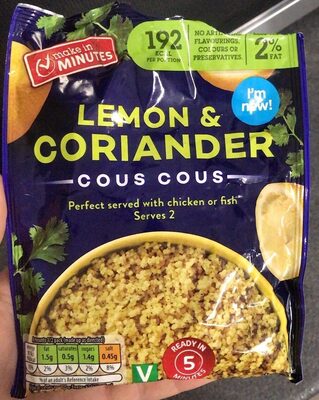
Aldi
Lemon and coriander cous cous
Sold at Aldi
Suits: dairy-free
Check the label: flare-friendly (low residue), onion- and garlic-free
Not suitable: no high-FODMAP ingredients found, gluten-free
Ingredients from Open Food Facts, last updated 27 March 2026. Checked against our rules on 22 November 2026.
Diet check
- Flare: checkCheck the label
It has 2.1 g of fibre per 100 g, a little above our 2 g limit.
- Onion/garlic: checkCheck the label
Lists flavouring, which can include onion or garlic. Check with the maker.
- High-FODMAP ingredientNot suitable
Contains barley, wheat.
- Contains glutenNot suitable
Contains barley, durum, semolina, wheat.
- Dairy-freeSuitable
Flare-friendly (low-residue) alternatives

Waitrose
Coconut lime and coriander rice
Waitrose

Lidl
Mediterranean Cous Cous
Lidl

M&S FOOD
Stir Fry Chilli & Coriander Noodles
M&S
Sainsbury's
Greek Style Lemon Rice, Limited Edition 250g
Sainsbury's

Tilda
Lemon & Herbs Basmati Rice

Tilda Limited
Lime & Coriander Basmati Rice

Sainsbury's
2 Pizza Bases
Sainsbury's

BRAMWELLS EXPRESS
ASIA INSPIRED RICE JAPANESE STYLE KATSU CURRY delicious chicken flavour curry rice
Aldi
Questions about Lemon and coriander cous cous
Is Aldi Lemon and coriander cous cous onion- and garlic-free?
Not confirmed. Lists flavouring, which can include onion or garlic. Check with the maker.
Is Aldi Lemon and coriander cous cous low FODMAP?
Probably not for the strict stage of a low FODMAP diet: it contains barley, wheat.
Is Aldi Lemon and coriander cous cous gluten-free?
No. It contains barley, durum, semolina, wheat.
Is Aldi Lemon and coriander cous cous OK during a Crohn’s or colitis flare?
Possibly. It has 2.1 g of fibre per 100 g, a little above our 2 g limit.
Is Aldi Lemon and coriander cous cous dairy-free?
Yes: its ingredients include no milk, cream, butter, cheese, whey or lactose.
Ingredients
DRIED COUS COUS (90%) (Durum Wheat Semolina), Maltodextrin, Flavouring (contains Barley, Celery, Soya, Wheat), Palm Oil, Dried Coriander, Salt, Lemon Peel, Ground Turmeric.
Nutrition per 100 g
| Energy | 147 kcal |
|---|---|
| Fat | 1.1 g |
| of which saturates | 0.4 g |
| Carbohydrate | 27 g |
| of which sugars | 1.1 g |
| Fibre | 2.1 g |
| Protein | 6 g |
| Salt | 0.3 g |
Related articles

Shopping for Crohn's disease: a basket that works for you
There is no single Crohn's diet. Here is how to shop when you are well, when you are flaring, and when your IBD team gives you specific advice.

Gluten-free labels explained: what each phrase means
UK labels use several different gluten phrases, and they don't all mean the same thing. A guide for people with coeliac disease.

What "low residue" means and how we pick flare-friendly food
Low residue usually means low fibre. Here is what NHS dietitians include, how we decide a product is flare-friendly, and why some show "check the label".